
Disclaimer: This article/guide/resource is to be used for informational purposes only and does not constitute financial, business, legal or tax advice. Individuals/businesses should consult with their own accountant, business advisor, or tax advisor with respect to matters referenced in this article/guide/resource. Affinity Ledger assumes no liability for actions taken in reliance upon the information contained herein see [Terms and Conditions]. Copyright: All Works on displayed on hubpoint.info are copyrighted unless otherwise stated:
The Accounting Process in Business
Accounting Process
The flow of money coming into a leaving a business can create numerous transactions. Businesses make a lot of purchases, pay a lot of expenses, owe money to several different suppliers, generate sales, and collect money from its customers.
These transactions must be tracked so that the company would be able to determine its financial standing, pay its bills, chase its debtors, and make sure it is making a profit. The responsibility of documenting these important transactions goes to the bookkeeper.
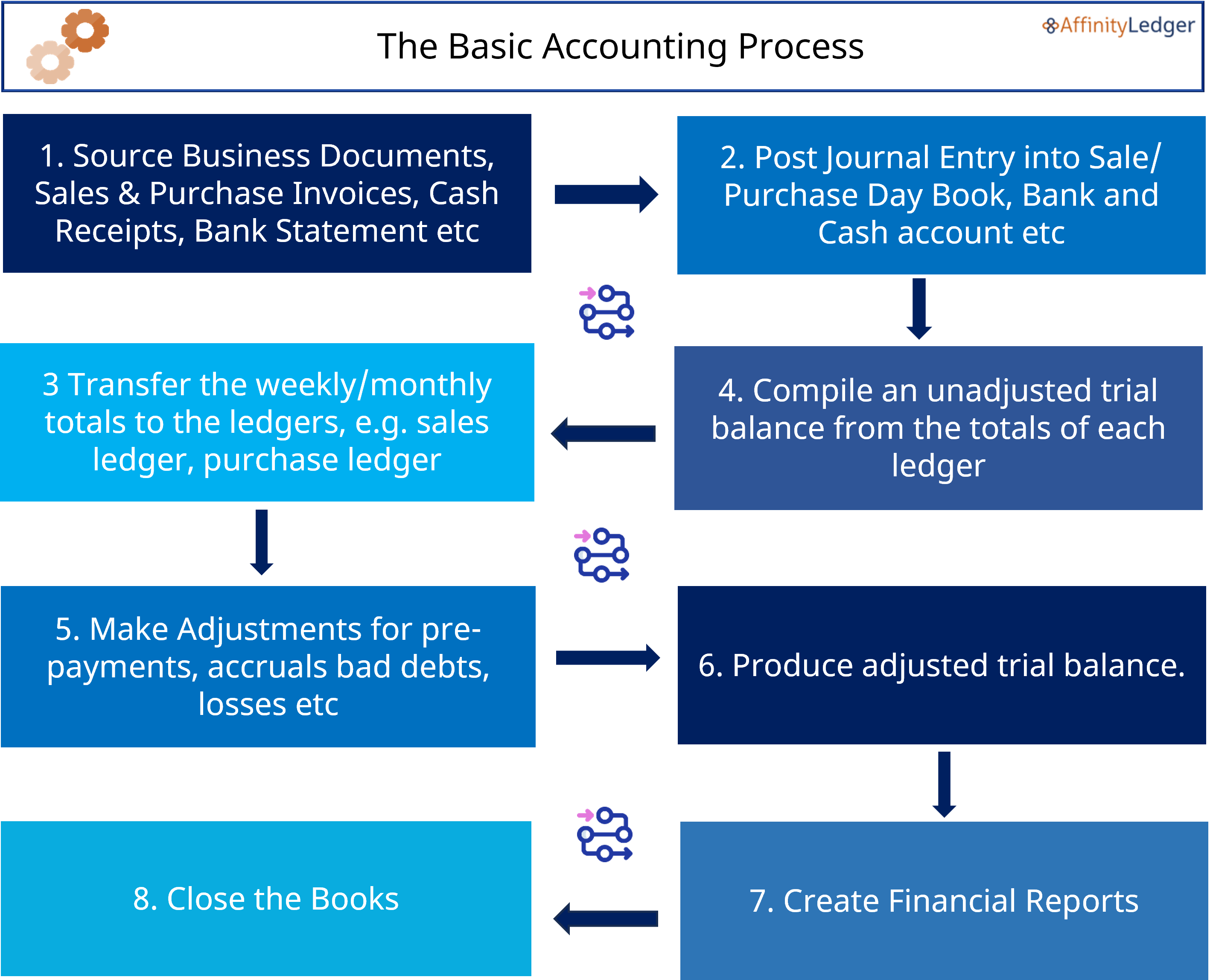
Business Documents
Typically, a business follows a standard bookkeeping process. Normally, during the course of a business transaction, a document is produced, these are classed as source documents. Examples of these documents are invoices or receipts, which are issued for sales and purchases. Deposit slips are produced when the business deposits money to their bank accounts. Checks are used to pay certain accounts.
Recording in Journals
The first part of the bookkeeping process involves recording the details of these documents into multi-column journals called daybooks. Each journal corresponds to a specific transaction. For example, credit sales are recorded in a sales journal, purchases are recorded in a purchasing journal and cash payments are recorded in a cash payments journal. The transactions can either be recorded singly for single-entry bookkeeping or twice for double-entry bookkeeping.
Posting to the Ledger Accounts
After a period of time, usually a month, the columns in each journal are added to give a summed total. This is the second part of the bookkeeping process. The summaries are then posted to their respective accounts in the general/nominal ledger, or book of accounts.
The Trial Balance (Un-adjusted)
After all balances are posted the accounts from the general/nominal ledger they are then transferred to a working document called an unadjusted trial balance. This part of the bookkeeping process allows the bookkeeper to quickly check the posting process was done accurately. All debit balances are posted to the debit side and all credits are posted to the credit side of the trial balance. The two columns are then totalled, if the totals do not match then there is a n error.
Checking for Errors
The two totals must be the same. If the two totals are not the same, an error has been made in either the journals or the posting process. The bookkeeper will need to check for posting errors and correct theses error before continuing. The totals of the debit and credit column must be recalculated before proceeding.
Adjusted Trial Balance
Assuming there are no errors or any errors are corrected, the bookkeeper can proceed to the next stage of bookkeeping process. This includes adjustments such as pre-payments and accruals. These adjustments are completed using double entry-bookkeeping method this ensures that the trial balance remains in balance This produces a report called the adjusted trial balance.
Financial Statements
The altered accounts in this list and their corresponding debit or credit balances are used to make the company’s financial statements such as the profit and loss statement and the balance sheet. The two totals must be the same.r bookkeeping? If the answer is yes, check out our single entry accounting system guide.


